
Your Go-To Cures for the Winter Blues? A New Scientific Review Casts Surprising Doubts
As the days shorten and the light fades, many of us feel a familiar slump in energy and mood. It's the common experience of the "winter blues," and the advice we receive is often just as common: exercise more, change your diet, maybe get a little more sun. This is the "common sense" approach to managing Seasonal Affective Disorder (SAD) and its milder forms.
But what does the latest scientific evidence actually say about these lifestyle fixes? Do they work, or are they just placebos we've come to believe in? A recent comprehensive systematic review published in the Journal of Psychiatric Research looked into this very question, and its findings are not what most people would expect. The truth about what works—and what we can prove works—is far from settled.
The Biggest Surprise: We're Mostly Guessing.
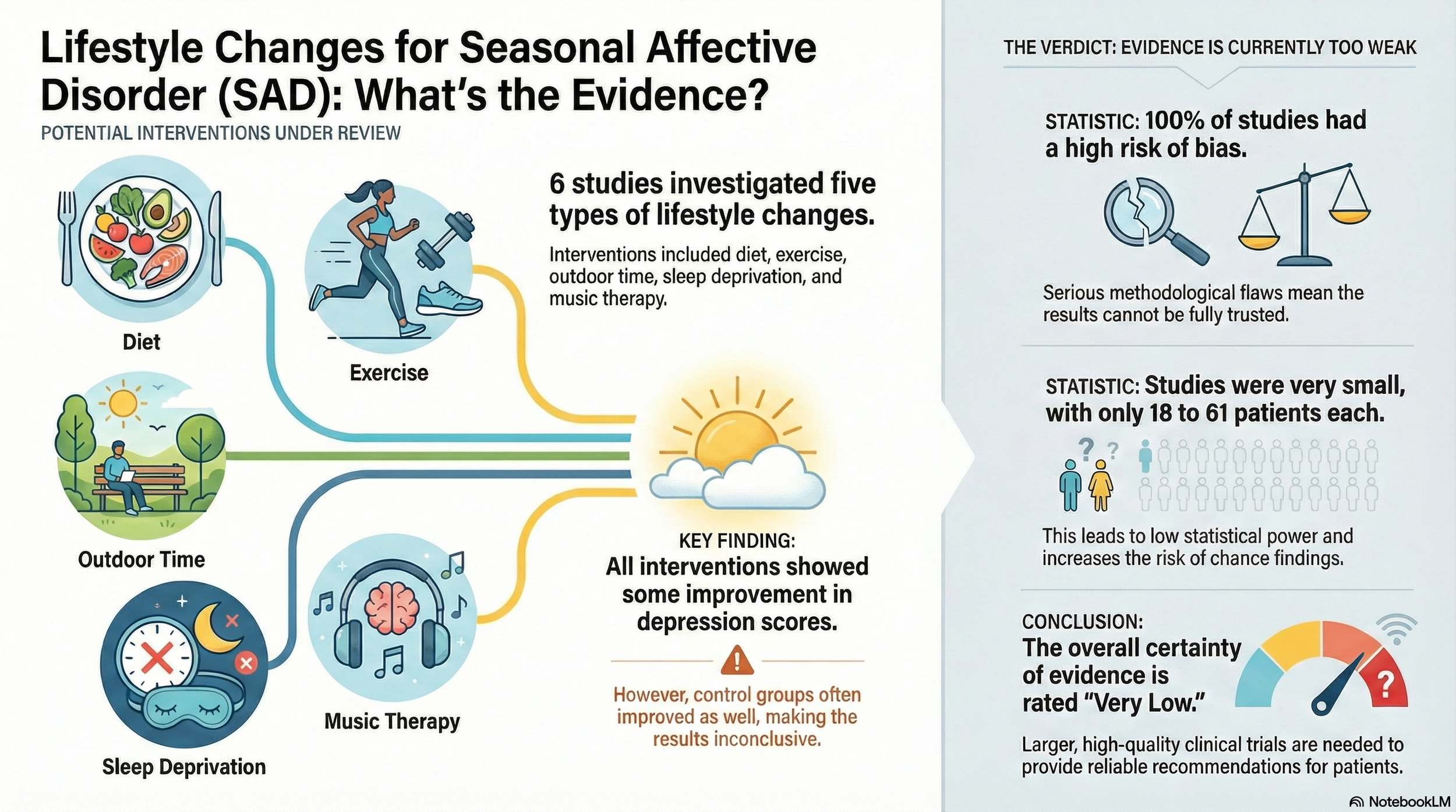
The most significant and overarching finding from the systematic review is that the overall scientific evidence for the effectiveness of lifestyle interventions for SAD is "very limited." Researchers scoured the scientific literature, screening over 1000 potential studies, but could only identify 6 randomized controlled trials that met their inclusion criteria, and even these were flagged as having a high risk of bias.
This is a critical revelation. While many patients prefer to try lifestyle changes before medication or other therapies, there simply isn't enough high-quality data for doctors to make solid, evidence-based recommendations. The review's authors put it bluntly:
"...due to the small number of studies found, too small sample sizes and methodological limitations, we cannot draw a valid conclusion about the effectiveness of lifestyle-modifying measures in SAD patients."
That Comforting Carb-Rich Snack Might Just Be a Placebo.
One of the most common symptoms of SAD is a craving for carbohydrates. It feels intuitive that a carb-rich snack or meal would boost our mood. However, two studies by Mischoulon et al. (2010) tested this very idea by giving participants either a high-carbohydrate mixture or a placebo mixture.
The results were stunning. While patients in both groups did feel better, significant improvements in depression scores were seen after taking both the high-carb mixture and the placebo. The most counter-intuitive finding was that there was no statistically significant difference in improvement between the two groups. In fact, in one of the studies, the remission rates after three weeks were identical: 71% for the carbohydrate group and 71% for the placebo group. This suggests that our psychological expectations may play a much larger role in "comfort food" than the food itself—a powerful reminder of the placebo effect, especially since the review flagged these studies, like all others included, with a high risk of bias.
A Simple Workout Could Rival a Dedicated Light Box.
Bright light therapy (BLT), using a specialized light box, is a first-line, proven treatment for SAD. So how would a simple lifestyle change like exercise stack up? Two studies included in the review made a direct comparison, and the results hint at the potential of physical activity.
One study (Putilov et al., 2005) found that a daily one-hour exercise program for a week led to a significant reduction in depression scores, and there was no statistically significant difference when compared to the effect of BLT. The other study (Pinchasov et al., 2000) also showed positive results for both exercise and light therapy, but the researchers never statistically tested the difference between them—a crucial omission that weakens the conclusion.
Adding another layer of uncertainty, the review's authors note that the participants in these two studies may have been the exact same group of people, meaning the evidence is even thinner than it first appears. It’s a tantalizing result, but one that underscores the review's central theme: we have promising clues but very little solid proof.
A Sunny Vacation Isn't a Guaranteed Upgrade.
Escaping the winter darkness for a sunny destination seems like the ultimate cure for SAD. A study by Putilov & Danilenko (2005) put this idea to the test. They had one group of patients take a one-week vacation to a more southern region (Turkmenistan) combined with light therapy, and compared their results to a group that only received light therapy at home.
The surprising outcome? Adding the sunny vacation did not produce a significantly better result than just using light therapy by itself. This suggests the fantasy of a "geographical cure" may be just that—a fantasy. The hard work of managing SAD appears to be less about a temporary change of scenery and more about consistent intervention, wherever you are.
The Paradoxical Power of a Sleepless Night.
Perhaps the most counter-intuitive finding of all comes from a study on sleep deprivation (Putilov et al., 2005). For people struggling with low energy and a desire to oversleep, intentionally staying up all night seems like the worst possible advice.
Yet, the study found that just one night of sleep deprivation produced a significant reduction in depression scores among SAD patients. This finding turns our intuitive understanding of wellness on its head. In a condition defined by low energy and a desire to oversleep, one of the most powerful short-term interventions might be to radically do the opposite, highlighting the incredibly complex relationship between our circadian rhythms, sleep, and mood.
What Should We Do This Winter?
The core message from this comprehensive review is clear: the science on lifestyle fixes for SAD is still in its infancy, and more high-quality research is desperately needed. We are still guessing more than we know.
While the evidence isn't conclusive enough to make official recommendations, the findings offer valuable clues. The very act of doing something proactive seems to make people feel better, as the powerful placebo effect in the diet studies showed. And of all the proactive steps examined, a consistent routine like daily exercise appears to hold the most promise, even if the evidence remains shaky. This suggests that the benefit may lie in the intersection of a plausible intervention (exercise) and the psychological power of taking control.
Given that many of these interventions made people feel better even without clear proof, what does that tell us about the power of simply taking active, intentional steps to manage our well-being?