
Color vs. Power: New Research Upends Everything We Thought About Light Therapy for SAD
As the days grow shorter and the skies turn gray, many people experience a familiar dip in mood and energy. For some, this seasonal shift is more severe, manifesting as Seasonal Affective Disorder (SAD), a subtype of depression with its own distinct diagnostic criteria. In response, light therapy has emerged as a popular and widely studied treatment, offering a way to counteract the lack of natural sunlight.
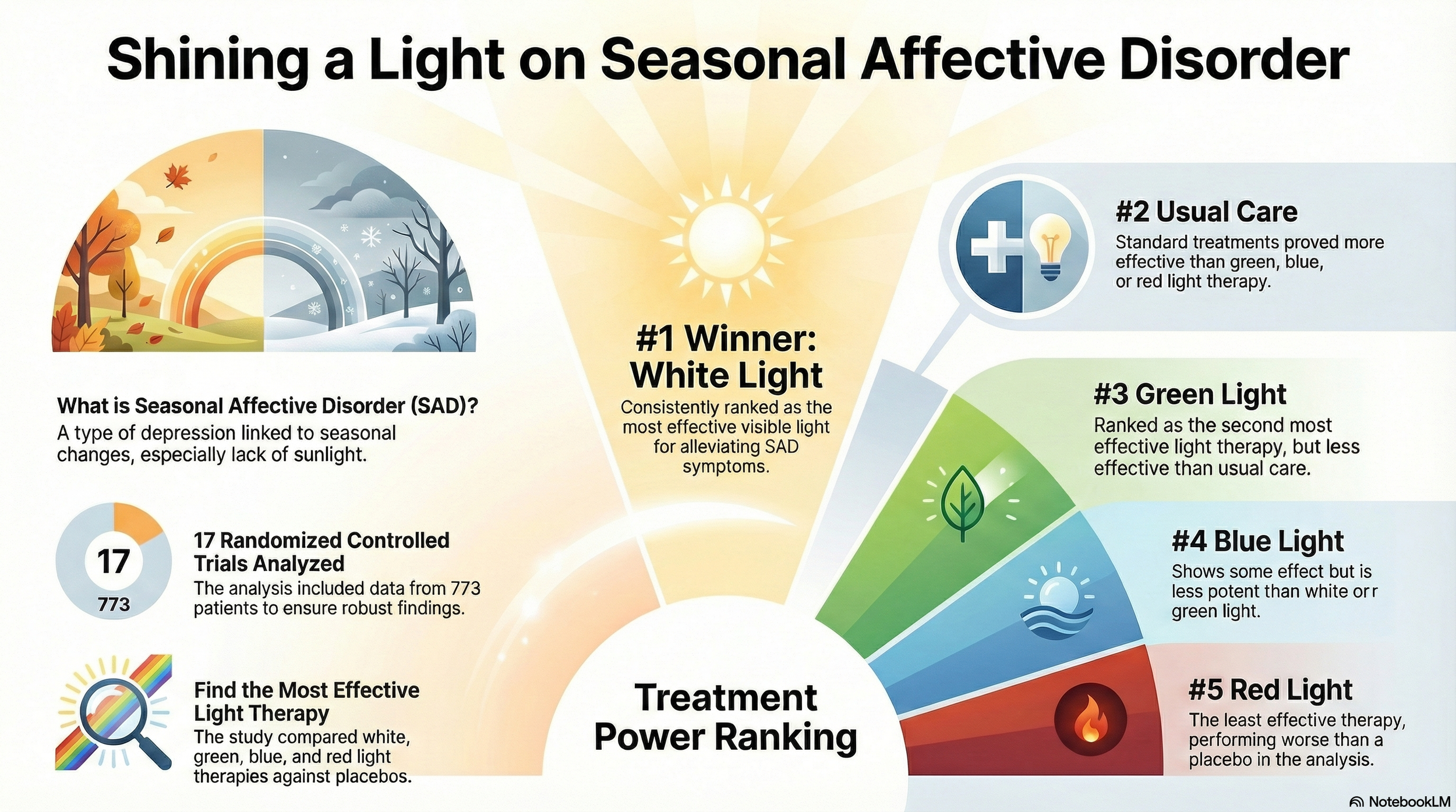
But while many have heard of using light boxes to combat SAD, a crucial question often goes unasked: Does the color of the light actually make a difference? Or is it simply its power? Fortunately, a major new systematic review and network meta-analysis has synthesized the evidence from 17 different randomized controlled trials involving a total of 773 patients to reveal some counter-intuitive and impactful truths about which colors work best—and which ones don't work at all.
1. Bright White Light Is the Clear Winner
The most significant finding from the comprehensive analysis is unambiguous: white light is the most effective visible light therapy for alleviating the symptoms of SAD. Across multiple measures, it consistently outperformed other colors in improving mood and reducing depressive symptoms.
The likely reason for its success is that white light is a composite light, meaning it contains a broad spectrum of wavelengths that closely mimic natural sunlight. By simulating the sun, it provides the powerful environmental cues our bodies need to regulate mood and sleep patterns. However, the study also highlights that the central explanation for its success may be its sheer intensity. Many of the white light trials used a very high illuminance of 10,000 lux—the standard for "Bright Light Therapy." As the researchers note, this suggests that the brightness of the white light, not just its color, may be the main reason for its superior performance compared to other colors that were often tested at much lower intensities.
The existing evidence suggests that white light may be the best visible light therapy for patients with SAD...
2. Blue Light's Promise Doesn't Quite Hold Up
Theoretically, blue light should be a powerful tool for treating SAD. Our eyes contain special photoreceptors (intrinsically photosensitive retinal ganglion cells, or ipRGCs) that are particularly sensitive to blue wavelengths. This sensitivity means blue light has a strong effect on suppressing melatonin, the hormone that regulates sleep, making it a promising candidate for resetting the body's internal clock.
Despite this strong scientific rationale, the analysis revealed a surprising result: blue light was ranked as less effective than both white and green light for treating SAD. This points to what some researchers call the "blue light paradox." While exposure to blue light in the morning can be beneficial for sleep rhythms and alertness, exposure in the evening can delay those same rhythms, negatively affecting both mood and sleep quality. Some studies have even linked nighttime blue light exposure to an increased risk of depression, adding a crucial layer of nuance to its use as a therapy.
3. 'Usual Care' Can Be More Effective Than You'd Think
In another unexpected finding, the review concluded that "usual care" was more effective than green light therapy for improving seasonal mood issues. "Usual care" is a broad category of established treatments that can include dawn simulation, pharmacological treatment (like fluoxetine), and psychological treatment (like Cognitive Behavioral Therapy, or CBT).
This finding contains a fascinating insight into the complexity of green light itself. While the analysis showed green light had the highest estimated effect of any color, it also demonstrated "low stability" and was ultimately ranked as less probable to be the best intervention than white light. The study authors suggest a possible reason: green light might reduce neuroinflammation associated with SAD, but could also simultaneously "increase depressive expression," making its use more complex than previously thought. This underscores that while light therapy is a powerful tool, it's not always the single best option, and a holistic approach that includes other evidence-based treatments is crucial.
4. Red Light Is Largely Ineffective for SAD
The analysis ranked red light as the least effective option by a wide margin. The study notes that red light is known to have a "strong placebo effect," but in one of the study's two main analyses, it actually performed worse than a placebo.
The scientific explanation for this is straightforward. The treatment of SAD relies on light signals being received through the eyes to regulate the brain's circadian rhythms. Red light, with its long wavelength, has a much weaker effect on the key photoreceptors in the retina responsible for this regulation compared to white, blue, or green light. Because it doesn't properly stimulate the biological pathways that govern our internal clocks, it is unable to produce the therapeutic effect needed to combat the symptoms of SAD.
Not All Light Is Created Equal
For years, the promise of light therapy has been linked to the biological power of specific colors, especially the clock-setting potential of blue light. Yet, this comprehensive review makes one thing abundantly clear: in clinical practice, the sheer power of bright, full-spectrum white light decisively outperforms more targeted colored lights.
The evidence reveals a distinct hierarchy of effectiveness: bright white light stands out as the top performer, followed by the complex case of green light, then blue light, while red light falls flat, proving to be clinically ineffective. This research suggests that when it comes to treating the winter blues, the intensity of the light may be a more critical factor than its specific color. As the science becomes clearer, what role will personalized light 'prescriptions' play in the future of our daily well-being?