
The Perfectionism Trap: 5 Surprising Truths About Why High-Achieving Black Women Are So Burned Out
1.0 Introduction: The Polished Surface and the Turbulent Depths
When Cheslie Kryst, the brilliant lawyer, entertainment reporter, and former Miss USA, died by suicide in early 2022, a shocked public echoed a familiar sentiment: "She seemed so happy." Kryst was a celebrated, highly visible example of success, embodying the popular ideal of "Black Girl Magic." Her tragic death laid bare a painful paradox—the profound disconnect that can exist between the polished surface of high achievement and the turbulent depths of an individual’s internal struggle.
A recent study from the Psychology of Women Quarterly offers a powerful new lens for understanding this pressure. It moves beyond simplistic explanations to reveal a surprising and critical truth: for many high-achieving Black women, perfectionism isn't an innate personality trait. It is a complex, exhausting, and often necessary survival strategy for navigating a world of limiting stereotypes.
This article breaks down the five most impactful takeaways from this research, revealing the hidden burdens of Black excellence and the steep costs of managing others' perceptions.
2.0 Takeaway 1: Perfectionism Isn't a Personality Trait—It's a Defense Mechanism
The foundational finding of the study reframes our entire understanding of perfectionism for Black women. It suggests that these tendencies are often a form of "stereotype management"—a defense mechanism developed in direct response to systemic racism and sexism, particularly within predominantly white institutions.
This simple but profound shift in perspective is critical. It recasts perfectionism not as an individual choice or a personal flaw, but as a rational and necessary adaptation to an inequitable environment. When a person's intelligence, competence, and even their emotional state are constantly under unfair scrutiny, striving for flawlessness becomes a tool for survival and self-preservation.
The researchers cite a powerful summation of this idea:
Black women are not perfectionists because this is an innate per-sonality trait, but because of the larger system of race based dis-crimination we operate within. (Yeboah, 2022, para. 10)
This reframing is vital because it shifts the focus of the conversation. The problem is not something that needs to be "fixed" within the individual. Rather, we must examine the environments that create and enforce these unbearable pressures in the first place.
3.0 Takeaway 2: The Three Invisible Stereotypes Driving the Pressure
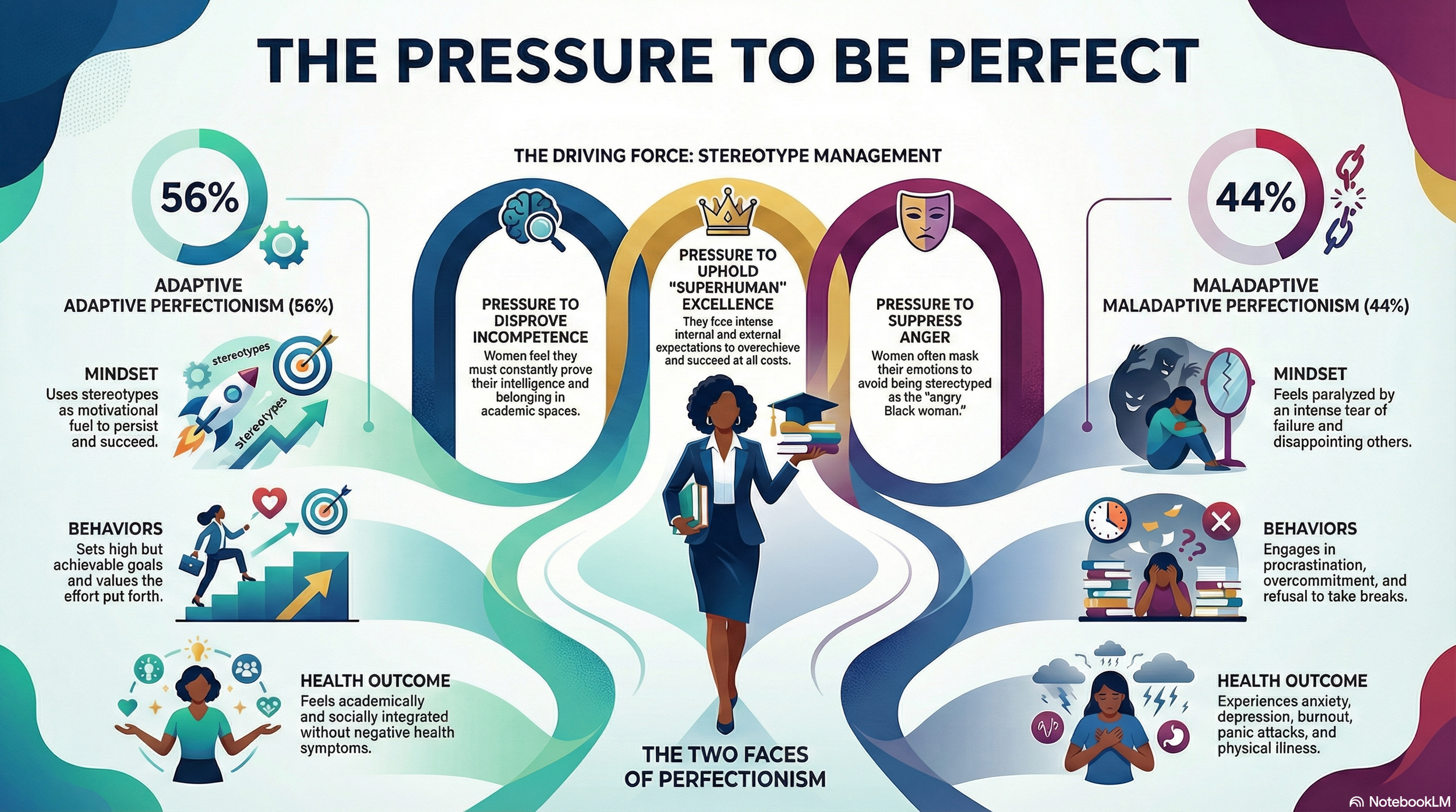
The study identified three specific and pervasive gendered racial stereotypes that participants felt a constant, pressing need to manage. These stereotypes act as an invisible architecture of pressure, shaping their behaviors, goals, and mental health.
3.1 Presumptions of Incompetence
This is the pressure to constantly disprove negative assumptions about one's intelligence and ability. Women in the study described feeling as though they had to relentlessly "prove" they were worthy of their academic and professional opportunities. They recounted experiences with peers and even guidance counselors who insinuated their acceptance into selective universities was due to a "race card," invalidating their hard-earned achievements and forcing them into a defensive posture of over-performance.
One participant, Ciara, recalled a particularly telling interaction: "We were talking about colleges and I was like, ‘I hope I get in.’ And he said, ‘Oh, you’ll get in—the race card.’ That infuriated me! I don’t get in because I’m Black."
3.2 Presumptions of Excellence
Paradoxically, the "superhuman" expectation creates its own crushing weight. This is the pressure to embody "Black Girl Magic" or emulate hyper-competent media figures like Olivia Pope. This expectation, often reinforced by family and society, can lead to over-extending oneself by taking on an impossible number of commitments. It fosters an intense fear of making any mistake, lest it shatter the fragile image of effortless excellence.
As a student named Kaja explained, "You can’t be just like normal because then it’s like you’re not trying enough...Do I need a stack of three majors? Do I need 20 internships?...It’s always this extreme, extreme version of perfection."
3.3 Presumptions of Anger
This is the pressure to meticulously police one's own emotions to avoid being labeled with the "angry, Black woman" stereotype. The study found that this pressure caused women to mask their true feelings, intentionally make themselves less visible in class discussions, and feel a constant strain from being unable to show up as their authentic selves. Challenging an idea, expressing frustration, or being assertive—all normal behaviors in an academic setting—become fraught with risk.
Hannah, a participant in the study, described the mental gymnastics this requires: "I consciously, for a long time, made sure that I wasn’t perceived as that. Like, oh, maybe I should smile more, or maybe I should be more agreeable...The academic space is really weird. Like, how much do you talk or how much do you not talk?"
4.0 Takeaway 3: The High Cost of "Shifting" to Survive
To manage these stereotypes, many women engage in practices that parallel what scholars have called "shifting"—the act of modifying one's behaviors, mannerisms, and language to align with Eurocentric norms and counter racist and sexist assumptions. While potentially effective for navigating certain spaces, this constant self-monitoring requires immense energy and emotional labor.
Shifting is an invisible, full-time job layered on top of academic and personal responsibilities. It is the conscious decision to change one's vocabulary, soften one's tone, or suppress a reaction. As the researchers note, this parallels the concept of "shifting" described by scholars Jones and Shorter-Gooden (2004), who defined it as an exhausting, daily practice:
...shifting “is working overtime when you are exhausted to prove you are not lazy. It is the art of learning to ignore a comment you believe is racist…or addressing [racism] in a way that doesn’t [leave you] labeled as aggressive.” (as quoted in Leath et al., 2025)
This relentless emotional regulation is not without consequence. The study links these shifting practices directly to severe mental health outcomes, including anxiety, lower self-esteem, and depression. It is a coping mechanism with a dangerously high cost.
5.0 Takeaway 4: The Fine Line Between "Motivation" and "Meltdown"
The research revealed a crucial and somewhat surprising finding: the women in the study responded to these intense pressures in two very distinct ways, highlighting the thin line between using pressure as fuel and being crushed by it.
First, some practiced "Adaptive Perfectionism." For these women—20 participants, or 56% of the sample—the external pressure became a form of "motivational fuel." They consciously used the awareness of stereotypes as a reason to work harder, set exceptionally high goals, and persist in the face of obstacles. In the short term, they often achieved their goals without reporting immediate negative health effects.
Second, others experienced "Maladaptive Perfectionism." This is the point where the pressure becomes debilitating. For these women—16 participants, or 44% of the sample—the intense fear of failure and the need to meet others' expectations became overwhelming. They reported significant mental and physical health issues—including anxiety, depression, and burnout—stemming from behaviors like procrastination born from a fear of failing, overcommitment to campus responsibilities, and a refusal to take breaks even when ill.
The key insight here is that even the "adaptive" response is still a reaction to an unfair and heavy burden. The fact that nearly half of the women experienced severe negative health outcomes shows just how fragile this coping strategy is and how easily the line between motivation and meltdown can be crossed.
6.0 Takeaway 5: The "Superwoman" Can Be a Mask for a Health Crisis
The study explains how the "Superwoman Schema"—the internalized pressure to project an image of strength and self-reliance—can lead women to mask their emotional and psychological distress. This outward performance of being "strong enough" can be tragically effective, misleading friends, family, and mentors into believing everything is fine.
One of the most powerful anecdotes from the study came from a student who would tell people, "I'm not okay," but framed it as a joke. Because she was high-achieving and seemed to have everything together, no one understood that she was making a genuine plea. They simply could not see past the mask of her success.
This finding brings us back to the tragic story of Cheslie Kryst. The research provides a scholarly framework for understanding the devastating gap that can exist between a public persona of flawless success and a private, deeply painful mental health struggle. The mask of the "Superwoman" is not a sign of strength, but a symptom of a crisis that is too often invisible until it is too late.
7.0 Conclusion: Beyond Resilience
Ultimately, this research makes a compelling case that the intense perfectionism observed in so many high-achieving Black women is not a personal failing but a systemic one. It is a logical, if costly, response to a society that subjects them to a unique and intersecting set of racist and sexist stereotypes.
The conversation around this topic often centers on teaching resilience and better coping skills. But after seeing the profound costs documented in this study, perhaps the more important question is this: Instead of asking Black women to become better at bearing these pressures, what would it take to dismantle the pressures themselves?