
The Juror’s Hidden Burden: 5 Essential Strategies for Managing Jury Duty Anxiety, Stress, and Mental Health
The Unspoken Weight of a Jury Summons
When a jury summons arrives in the mail, one of the first thoughts many people have is:
How long is jury duty?
What happens if I don’t show up for jury duty?
Can I be excused from jury duty for mental health reasons?
For many citizens, jury duty anxiety begins the moment the envelope is opened. Concerns about missed work, financial strain, childcare, and disruption to routine are common. But beyond the logistical stress lies a deeper, often unspoken issue: mental health and jury duty are closely connected.
Jury service is not just a civic responsibility—it is a psychological experience. Sitting through difficult testimony, reviewing disturbing evidence, and engaging in high-stakes deliberations can significantly impact emotional well-being.
If you are experiencing jury duty stress, panic symptoms, depression, or overwhelm, you are not alone.
Drawing from the work of Dr. Jessica C. Parlor and her Jury Duty Wellness Series, this guide offers evidence-informed strategies for coping with jury service stress while protecting your mental health.
1. Jury Duty Stress Is Real: Your Physical Health Impacts Your Judgment
One of the most searched concerns online is “jury duty anxiety” and “jury duty stress symptoms.”
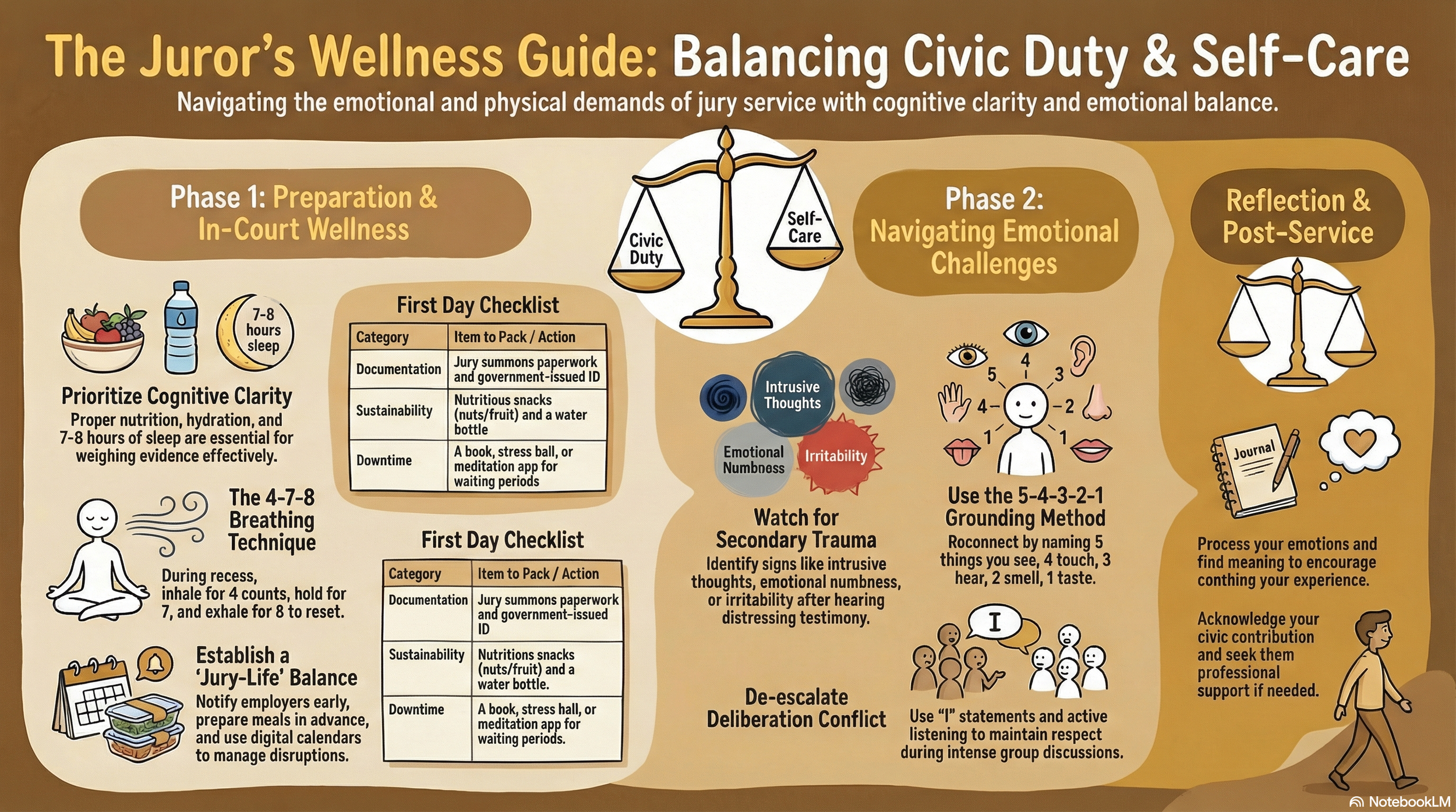
Research in cognitive science shows that sleep deprivation, dehydration, and poor nutrition impair the brain’s executive functioning. When jurors are exhausted, they are more vulnerable to:
Decision fatigue
Irritability
Implicit bias
Reduced concentration
Emotional reactivity
If you are asking, “Why am I so anxious about jury duty?” — part of the answer may lie in nervous system overload.
Practical Strategies:
Prioritize 7–8 hours of sleep during jury service.
Stay hydrated throughout the day.
Eat consistent, balanced meals.
Limit caffeine if experiencing jury duty panic disorder symptoms.
A healthy juror is a fair juror. Supporting your body supports the justice system.
2. Secondary Trauma in Jury Duty: What Many Jurors Don’t Expect
Another growing search trend is:
“secondary trauma jury duty”
“stress after serving jury duty”
“jury duty psychological impact”
Many jurors expect boredom. Instead, they encounter graphic testimony, emotional witness statements, or disturbing evidence.
This can result in secondary trauma, also known as vicarious trauma. Your nervous system may react as if you experienced the events directly.
Signs of Jury Duty–Related Emotional Distress:
Intrusive thoughts about case details
Difficulty sleeping after court
Emotional numbness
Heightened anxiety or irritability
Feeling overwhelmed or dissociated
If you’re searching, “Does jury duty cause anxiety?” — the answer is yes, it can.
Immediate Regulation Tool: 4-7-8 Breathing
When overwhelmed in the courtroom:
Inhale for 4 counts
Hold for 7
Exhale for 8
This reduces activation of the stress response and helps manage jury duty anxiety symptoms in real time.
3. Can You Be Excused from Jury Duty for Mental Health?
One of the most common online searches is:
“Can I be excused from jury duty for mental health reasons?”
The answer varies by jurisdiction, but courts generally allow for medical or psychological hardship documentation if a licensed professional provides appropriate verification.
Related high-search phrases include:
jury duty mental health excuse
excused from jury duty anxiety
jury duty depression exemption
how to write a jury duty mental health letter
If your symptoms include:
Severe panic attacks
Active PTSD symptoms
Major depressive episodes
Acute psychiatric instability
You may qualify for a jury duty medical exemption. Consult your provider and your local court guidelines.
However, many individuals with manageable anxiety can serve successfully with appropriate coping strategies and support.
4. Managing High-Conflict Deliberations Without Emotional Burnout
Search queries such as:
coping with jury service stress
jury deliberation anxiety
conflict in jury room
reflect the reality that deliberations can be intense.
High-stakes group decision-making activates social stress responses. Emotional regulation becomes critical.
Communication Strategies to Reduce Jury Room Stress:
Use “I” Statements
Instead of:
“You’re ignoring the evidence.”
Try:
“I’m having difficulty reconciling that testimony with the timeline we reviewed.”
Active Listening
Paraphrase before responding. This lowers defensiveness and prevents escalation.
Request a Break
If deliberations become heated, suggest a short recess. A five-minute reset can significantly reduce cognitive overload.
If you are wondering, “Is jury duty stressful?” — yes, especially during deliberation. Structured communication reduces burnout and preserves clarity.
5. The 5-4-3-2-1 Grounding Method for Jury Duty Anxiety
Another common search phrase:
“How to cope with jury duty anxiety during trial.”
Long hours of testimony can lead to dissociation or mental fatigue.
The 5-4-3-2-1 Grounding Technique helps interrupt the fight-or-flight response.
How to Use It in the Courtroom:
Name 5 things you can see.
Name 4 things you can physically feel.
Identify 3 sounds.
Identify 2 smells.
Identify 1 taste.
This sensory anchoring technique is particularly helpful for:
Jury duty panic disorder
Overwhelm during graphic testimony
Emotional flooding
Dissociation in court
It is a discreet and effective strategy for coping with jury service stress without disrupting proceedings.
6. Stress After Serving Jury Duty: Why Re-Entry Matters
Many people search:
stress after jury duty
depression after jury service
emotional effects of jury duty
PTSD after serving on jury
Once the verdict is delivered, psychological processing may just begin.
You may experience:
Emotional heaviness
Moral reflection
Sleep disruption
Irritability
Difficulty “switching back” to normal life
This does not mean something is wrong. It means your nervous system has been under sustained strain.
Post-Jury Mental Health Care:
Journal about the experience (without violating confidentiality).
Talk with a trusted friend or therapist.
Schedule a low-demand evening.
Prioritize rest and decompression.
If symptoms persist beyond several weeks, consult a mental health professional.
Jury Duty and Mental Health: A Civic Responsibility with Psychological Impact
Jury duty is one of the cornerstones of democracy. But it is also increasingly recognized as a meaningful mental health experience.
Common online questions reflect real concerns:
Is jury duty bad for mental health?
Does anxiety disqualify you from jury service?
Can jury duty cause trauma?
What are jury duty stress symptoms?
The truth is nuanced.
For many, jury service is manageable with preparation and regulation skills. For some, especially those with pre-existing anxiety, PTSD, or depression, additional support or exemption may be appropriate.
By understanding the connection between jury duty stress and mental health, you empower yourself to serve thoughtfully—or advocate for your well-being when necessary.
Final Reflection: Beyond the Jury Summons
The next time you receive a jury summons, it is normal to feel jury duty anxiety or stress. Instead of dismissing those feelings, approach them with informed awareness.
With preparation, nervous system regulation, and appropriate boundaries, you can protect your mental health while fulfilling your civic role.
And if you are currently searching:
“Can mental health issues get you out of jury duty?”
“How do I cope with jury duty anxiety?”
Know this: your well-being matters just as much as your civic obligation.