
Introduction: The Hidden Cost of "Perfect"
In job interviews and on social media, perfectionism is often presented as a strength in disguise—a "humblebrag" that signals a person's high standards and dedication. We tend to associate it with meticulous work and a drive for success. But beneath the surface of this popular "good" flaw, clinical psychology reveals a darker truth: for many, perfectionism isn't a superpower. It's a heavy burden linked to anxiety, depression, burnout, and relentless self-criticism.
This isn't just a personality quirk. Researchers define "maladaptive perfectionism" as a significant factor in a number of psychological disorders. The good news is that a growing body of scientific work is providing a clearer picture of what perfectionism truly is, where it comes from, and how its negative effects can be managed. A recent scientific review in the journal Verhaltenstherapie, titled "Cognitive-Behavioral Treatment of Perfectionism: An Overview of the State of Research and Practical Therapeutical Procedures," synthesizes this research, offering profound insights that challenge our common assumptions.
Here are five of the most surprising truths about perfectionism, according to the science.
--------------------------------------------------------------------------------
1. It’s Not About High Standards—It’s About Your Self-Worth
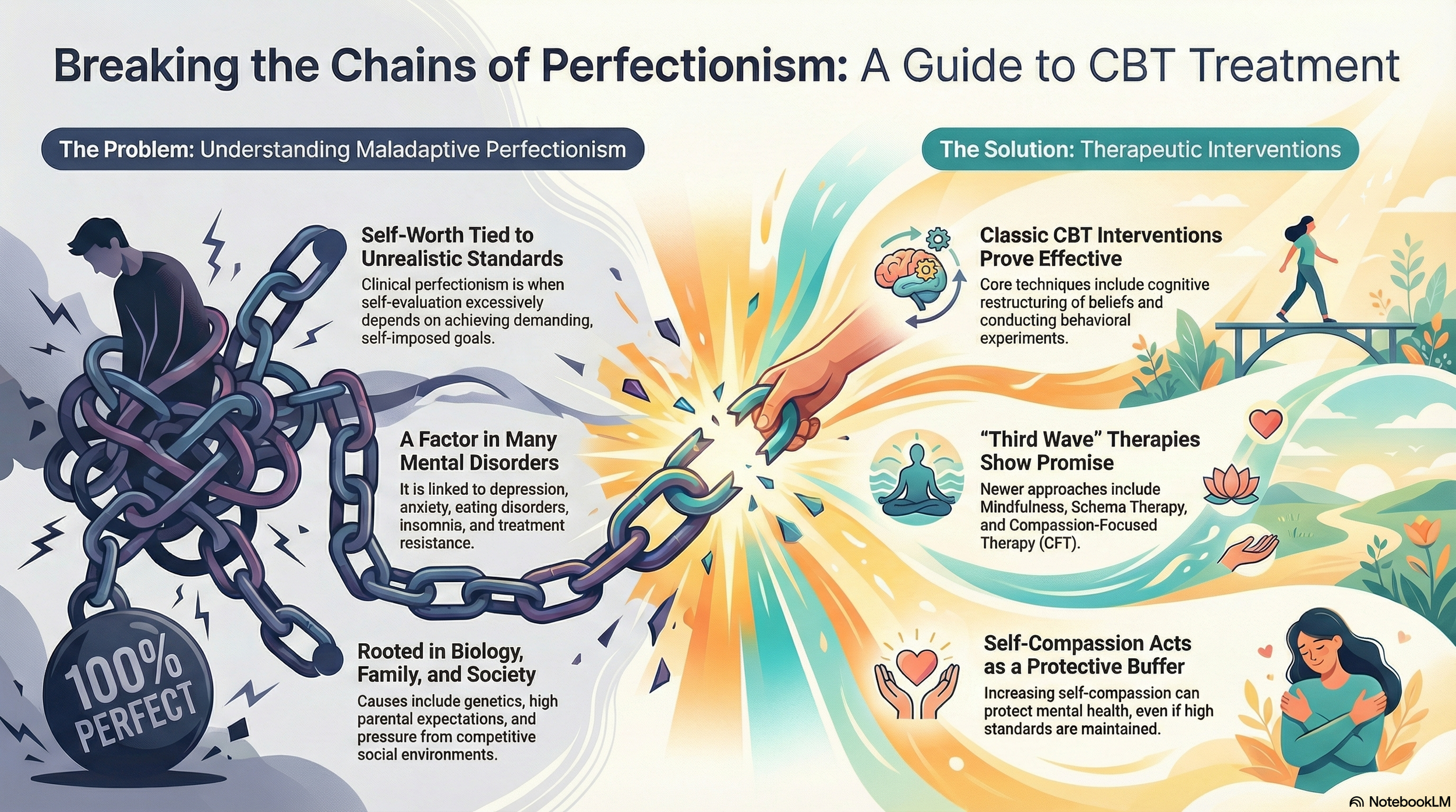
The core problem of clinical perfectionism isn't the desire to do well, but the reason why that desire is so intense. According to the leading cognitive-behavioral model on the topic, clinical perfectionism is the "excessive dependence of a person’s self-evaluation on striving for or achievement of demanding, self-defined goals." This is the core of the trap: the perfectionist continues this pattern despite the immense personal cost, such as high stress, self-criticism, and a constant fear of failure.
This distinction is critical. It shifts the focus from an external behavior (working hard) to a fragile internal experience (basing your entire value as a person on your performance). Someone with high standards might feel disappointed if they fall short of a goal, but a perfectionist may feel fundamentally worthless. Their self-esteem is not just influenced by their achievements; it is almost entirely built upon them. This makes any perceived failure feel like a direct threat to their very identity.
2. It's Often a "Safety Strategy" Rooted in Our Past
Perfectionism doesn't appear out of thin air; it often develops as a coping mechanism to navigate difficult early life experiences. Research suggests that it can function as a "safety strategy" to avoid interpersonal threats and secure a sense of stability. The review article identifies several key factors in its development, including high parental expectations, criticism, or even over-protectiveness that fosters a deep fear of making mistakes.
Diving deeper, the research points to a powerful underlying driver: social connection. The "Perfectionism Social Disconnection Model," for example, suggests that perfectionism often arises from a "perceived lack of social connectedness." It becomes a strategy to prevent abandonment or rejection. This is supported by studies linking perfectionism to specific internal beliefs, or "schemas," in the domain of "Disconnection and Rejection"—such as deep-seated feelings of Defectiveness, Social Isolation, or Abandonment.
This insight offers a more compassionate lens through which to view perfectionism. It’s not simply a personality flaw but a learned survival strategy that, at one point, may have served a protective purpose in a world that felt unsafe.
3. The No-Win Scenario: Success Just Raises the Bar
One of the most insidious aspects of perfectionism is the psychological trap it creates—a kind of psychological checkmate. The system is rigged so that a sense of lasting satisfaction is always out of reach, regardless of the outcome. The cognitive-behavioral model outlined by Shafran and colleagues in 2002 describes this vicious, two-part cycle:
1. If you fail: When a person with perfectionism fails to meet their impossibly high standard, it triggers harsh self-criticism. This, in turn, weakens their already fragile self-esteem and reinforces their belief that they must maintain—or even heighten—their standards to prove their worth.
2. If you succeed: When they do succeed, the relief is fleeting. Instead of feeling a sense of accomplishment, they "tend to consider their own standards as no longer demanding enough and subsequently increase them." The goalpost is immediately moved further away.
This creates a perfect no-win scenario. Failure confirms worthlessness, while success only proves that the challenge wasn't hard enough. The result is a perpetual state of striving without any of the rewarding feelings of achievement.
4. Sometimes, It's a Physical Sensation of "Not Just Right"
While we often think of perfectionism as a purely cognitive pattern—a set of rigid thoughts and beliefs—research shows it can also have a visceral, sensation-based component. This is known as "not just right experiences" (NJREs).
NJREs are described as a feeling of discomfort when an action or perception doesn't feel "quite right." The source review gives examples like hair that "does not sit 'just right'" or a text that "does not feel 'quite right or finished'." This phenomenon, also called "sensation-based perfectionism," shows a strong correlation with maladaptive perfectionism.
This insight is powerful because it validates a common but hard-to-describe experience. For many, the pressure to be perfect isn't just a thought—it's a persistent, bodily feeling of "wrongness" that they are constantly trying to fix. The drive for perfection isn't just an abstract idea like "I must not make a mistake"; it's a nagging, almost physical sensation that something is incomplete, and the only way to relieve that discomfort is through more checking, editing, or fixing.
5. The Best Antidote Isn't Lowering Your Standards—It's Self-Compassion
Given the intense fear of failure, the idea of simply "lowering your standards" can feel impossible or even terrifying to someone with perfectionism. But recent therapeutic approaches, often called "third-wave" cognitive-behavioral therapies, offer a more effective and palatable alternative: self-compassion. While researchers note that more high-quality studies are needed, these approaches show immense promise in treating perfectionism.
Research shows that self-compassion has a "protective or buffering effect against the pathogenic effects of perfectionism." Remarkably, this can protect a person's mental health even when they continue to maintain high standards. The goal isn't to stop striving, but to change how you treat yourself during the process. As the review's author, Melanie Wegerer, summarizes from the work of researcher Kristin Neff:
Self-compassionate people still strive for personal growth, but they are motivated more by an intrinsic interest in development than by external expectations. Because of this, they are less afraid of failure and more accepting of their own limitations.
This is a deeply hopeful and actionable insight. By learning to be kinder to yourself, you can fundamentally change your relationship with your goals. The motivation shifts from a fear-based need to prove your worth to an intrinsic interest in development, making the entire process less stressful and more sustainable.
--------------------------------------------------------------------------------
Conclusion: Beyond Perfect
Perfectionism is far more than a simple desire for excellence. As science shows, it is a complex pattern deeply tied to our sense of self-worth, our earliest relationships, and even our physical sensations. Understanding these hidden drivers is the first step toward reclaiming your self-worth from the impossible standards you've set. It's an invitation to shift your focus from the flawed pursuit of being perfect to the compassionate practice of being whole.
What could you achieve if you weren't afraid of being imperfect?