
5 Surprising Insights from Frantz Fanon That Radically Change How We See Race
Introduction: Beyond the Surface of Black Identity
In our modern, globalized world, the complexities of racial identity can feel more tangled than ever. We grapple with questions of heritage, nationality, and culture, trying to understand how they intersect and define us. For anyone seeking a deeper clarity, the revolutionary thinker Frantz Fanon remains an indispensable guide. Though written over seventy years ago, his seminal work, Black Skin, White Masks, continues to offer insights that are startlingly relevant and profoundly challenging to our contemporary assumptions.
Fanon, a psychiatrist and political philosopher from Martinique, dissected the psychological effects of colonialism and racism with unflinching precision. He refused to accept simple answers, instead digging into the unconscious structures that shape how we perceive ourselves and others. This article explores five of his most impactful and surprising ideas—concepts that cut through today's noise and force us to reconsider the very foundations of what it means to be Black.
Race Consciousness vs. the Color Complex
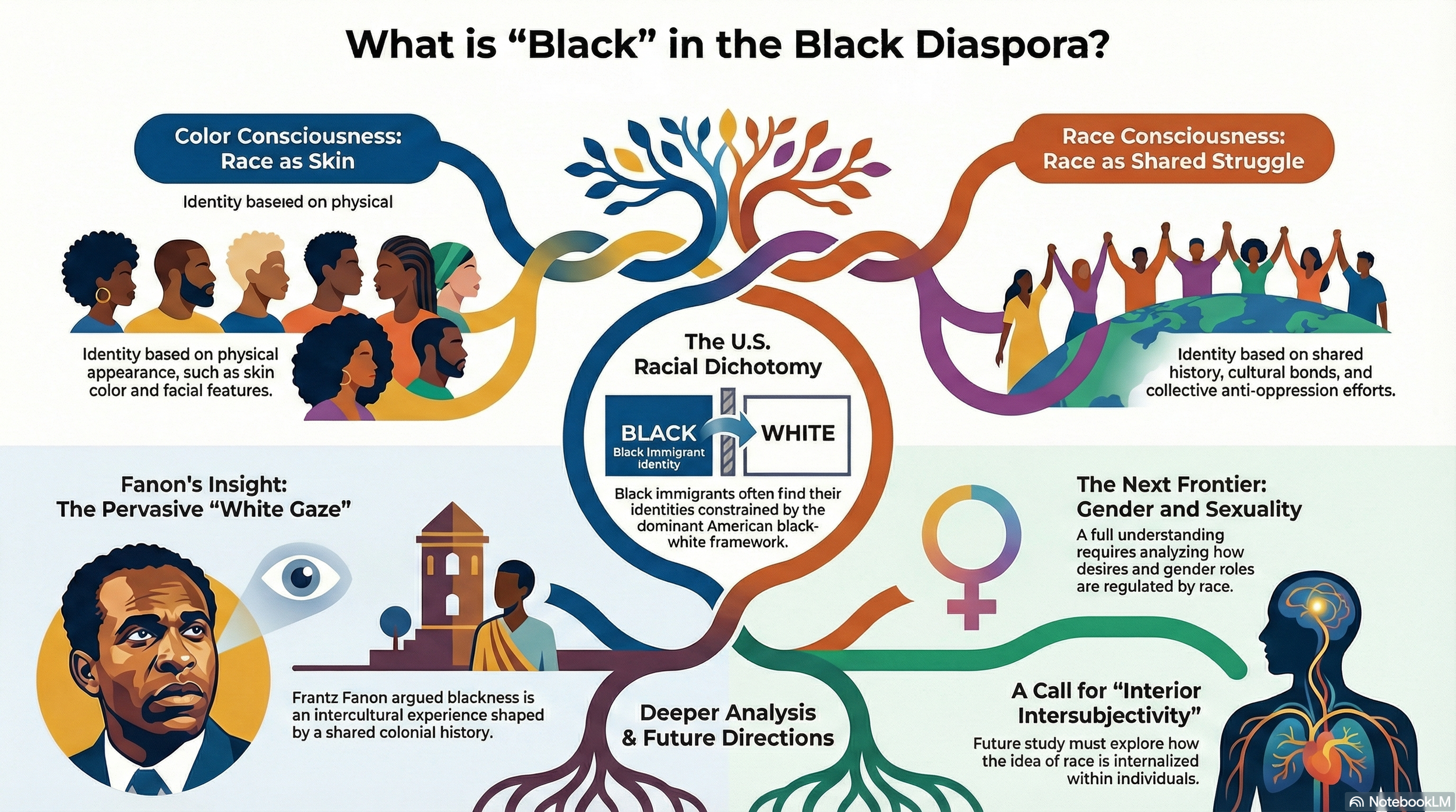
Fanon drew a sharp, and surprising, distinction between the experience of Blackness in the United States and in his native Antilles. He observed that Black Americans, forged in a history of direct and overt struggle, possessed a powerful "race consciousness." This was a collective identity built on shared cultural bonds and a unified fight against oppression.
Counter-intuitively, Fanon argued that this very struggle meant Black Americans had less of a "color complex"—the obsessive focus on gradations of skin tone (black, brown, yellow, mulatto) that he saw as pervasive in Antillean society. This distinction complicates many modern narratives about race and colorism. As powerful proof of this specificity, Fanon deliberately kept the phrase "twelve million black voices" in English within his original French text—a conscious choice to mark the untranslated, unique historical reality of the American context. He saw this context as one of active conflict and, therefore, active identity formation.
The French Negro is doomed to bite himself and just to bite. I say the French Negro, for the American Negro is cast in a different play. In the United States, the Negro battles and is battled. . . . There is war, there are defeats, truces, victories.
A Global "Collective Unconscious" of Racism
These differing local experiences, however, do not form in a vacuum. Fanon argued that racism was not merely a series of isolated national problems; it was a global, structural phenomenon. He posited that racial tropes and ideologies are part of a shared, transnational "collective unconscious" inherited from modernity's colonial history. These ideas cross borders with ease, adapting to local circumstances while retaining a common, destructive logic.
He pointed to the way simplistic American racial caricatures—like the "Sho' good!" type-Negro from films—were exported and readily adopted in France. This demonstrated that racial prejudice wasn't an organic local phenomenon but a product of a larger system. This insight remains powerful today, showing that fighting racism requires addressing a deeply embedded global structure, not just its local symptoms. Fanon insisted that European nations could not absolve themselves of responsibility by pointing to racism elsewhere.
M. Mannoni, you are wrong. For what is the meaning of this sentence: ‘European civilization and its best representatives are not responsible for colonial racialism’? . . . I said just above that South Africa has a racist structure. Now I shall go farther and say that Europe has a racist structure.
The Defining Power of the "White Gaze"
This global collective unconscious provides the very mechanism through which Fanon's most famous concept operates: the "white gaze." He argued that for the Black person, their identity is not simply an internal state of being but an external reality "fixed" by the perception of the white other. It is a fundamentally relational identity constructed under constant, defining pressure.
Fanon described this as being subjected to a "racial epidermal schema," a psychological prison where one’s skin becomes the ultimate signifier of one's entire existence. This isn't just about being seen; it's about being defined from the outside, having your ontological reality determined by another's perception. This powerful concept explains the immense psychological weight of navigating a world where your identity is constantly being created for you.
not only must the black man be black; he must be black in relation to the white man. . . . The black man has no ontological resistance in the eyes of the white man.
Theories of Race as Covert Theories of Desire
But to fully grasp the power of these racial structures, we must look at a dimension Fanon himself did not foreground: the way race is inextricably linked to desire and gender. To add a crucial layer that deepens Fanon’s analysis, cultural theorist Robert Young argues that historical theories of race were often "covert theories of desire." They were born from colonial fears of miscegenation and the urgent need to regulate sexual relationships to maintain racial purity.
This lens reveals a hidden layer in the logic of racism. The obsession with racial categories, hybridity, and creolization is inseparable from the impulse to police bodies and control desire. Whether through explicit anti-miscegenation laws or implicit cultural taboos, the "law" of race has always been about distributing and prohibiting pleasure and partnership along racial lines. This policing of desire to maintain racial purity inevitably creates a patriarchal structure, which in turn produces blind spots within liberation movements themselves, a point brilliantly articulated by bell hooks.
Race, Liberation, and the Gender "Blind Spot"
The essential fight for racial liberation can be so all-consuming that it overshadows other critical identity struggles, particularly those related to gender. The feminist critic bell hooks offers a powerful reflection on this dynamic in her reading of Fanon. She describes the experience of being so swept up in the "seductive passion" of the decolonial struggle that other parts of her identity fell away.
This "lust for freedom" can create a "blind spot," making it difficult to see and address injustices within a racial group, especially sexism and misogyny. When the primary struggle is framed as a unified racial front, critiques of internal gender dynamics can be sidelined or seen as divisive. Hooks’s insight shows that even in the most righteous movements for liberation, there is a constant need to remain vigilant about which identities are centered and which are marginalized.
When I first read [Fanon] I heard a new history spoken—the voice of the decolonized subject raised in resistance. ... Dying into the text, I abandoned and forgot myself. The lust for freedom in those pages awakened and resurrected me. In that moment of recognition, gender had no meaning.
Conclusion: A Man Who Questions
Frantz Fanon’s work does not provide easy answers or comfortable conclusions. Its enduring power lies in its demand for deeper, more difficult questioning. He forces us to look beyond surface-level politics and confront the psychological and structural complexities that define our world, from the force of the white gaze to the blind spots created by our own movements.
Fanon’s ultimate goal was not to provide a final definition of Blackness, but to open up the possibility of true human freedom. His ultimate response to the prison of the white gaze was not to reject the other, but to commit to a world of mutual recognition. He leaves us with a profound challenge, a prayer to embody a spirit of relentless inquiry in our own lives. As he wrote at the end of his book, he prayed that his body would make him "a man who questions," one whose freedom would consist of the desire "to build the world of the You."