You’re Not Crazy — You Might Just Be Growing (And Your Relationship Is Catching Up)
If you’ve been Googling:
Why does my relationship feel different?
Are we growing apart?
Is this relationship anxiety or a red flag?
How do I know if I’ve outgrown my relationship?
Should I stay or leave my relationship?
You are not alone.
One of the most common relationship problems people experience in long-term partnerships isn’t dramatic betrayal or obvious toxicity. It’s subtle discomfort. A quiet tension. A sense that something doesn’t “fit” the way it once did.
Before you assume your relationship is failing, consider this: relationship discomfort is sometimes a sign of personal growth — not incompatibility.
Growing Apart in a Relationship: Problem or Personal Evolution?
Search data shows rising interest in:
growing apart in a relationship
signs you’ve outgrown a relationship
why do relationships change over time
Relationships often begin at a specific developmental stage. The version of you who entered the relationship had certain needs, attachment patterns, insecurities, and hopes.
But people evolve.
What once felt like safety might now feel restrictive.
What once felt exciting might now feel misaligned.
The discomfort you feel may not be about your partner’s flaws. It may be about your identity evolving faster than the relationship structure.
Instead of asking, “What’s wrong with them?” try asking:
Who was I when this relationship began, and who am I becoming now?
That shift moves you from blame to growth.
Relationship Anxiety vs. Relationship Growth
A common search phrase is:
“Is this relationship anxiety or a sign I should leave?”
It’s critical to distinguish between:
Healthy relationship growth
Toxic relationship patterns
Attachment anxiety
Developmental change
Not all discomfort is a red flag.
Sometimes what feels like relationship anxiety is actually individuation — the process of becoming more yourself.
You may notice:
Pausing before agreeing to things you once accepted instantly
Wanting more autonomy or alone time
Needing deeper conversations
Feeling restless with old routines
Craving emotional maturity in relationships
These aren’t necessarily signs of a bad relationship. They may be signs of growth.
Signs You’ve Outgrown a Relationship (Without Villainizing Anyone)
Another high-traffic search:
“How do you know when you’ve outgrown someone?”
Outgrowing a relationship does not mean someone is toxic or wrong. It may mean:
Your values have shifted
Your attachment style is becoming more secure
Your goals no longer align
You require emotional depth that wasn’t necessary before
You are no longer willing to shrink to maintain harmony
Growth often feels like friction because the old dynamic was built around a former version of you.
You’re not “too much.”
You may simply be expanding.
Attachment Styles in Relationships: The Silent Driver
Many people search:
attachment styles in relationships
anxious attachment in relationships
avoidant partner signs
secure attachment traits
Relationship discomfort often activates attachment patterns.
For example:
Anxious attachment may interpret growth as abandonment.
Avoidant attachment may interpret growth as pressure.
Secure attachment allows for recalibration without panic.
As you evolve, your attachment style may shift toward greater security — which can disrupt old relational patterns.
That disruption is not dysfunction.
It may be maturation.
Stop Asking “Should I Stay or Should I Go?”
One of the most searched relationship questions online is:
“Should I stay or leave my relationship?”
Binary thinking creates panic.
Instead of asking whether to stay or leave, consider these relationship growth options:
1. Recalibrate
Adjust expectations, communication patterns, and daily rhythms to match who you both are now.
2. Redefine
Shift the structure of the relationship — for example, from romantic partners to co-parents or close friends.
3. Evolve
Allow the relationship to deepen into a more emotionally mature, values-aligned connection.
4. Release
Recognize compassionately that the relationship can no longer support your growth.
The question is not just “Should I stay?”
The question is: Does this relationship support the person I am becoming?
Relationship Boundaries Are Not Walls — They’re Alignment
High-volume search terms include:
relationship boundaries examples
how to set boundaries in a relationship
emotional boundaries in relationships
healthy relationship vs toxic relationship
Boundaries are not punishments. They are clarity.
When you define what you are “no longer available for,” you are not attacking your partner — you are aligning your behavior with your values.
For example:
No longer available for emotional dismissal
No longer available for one-sided emotional labor
No longer available for suppressing your truth to keep peace
If you are hesitating to change, ask yourself:
What is the cost of staying the same?
Often the cost is:
Self-trust
Vitality
Emotional safety
Authenticity
Healthy relationships make room for growth. Toxic relationships demand stagnation.
Grief Is Part of Relationship Growth
Search trends show rising interest in:
grief after breakup
grieving a relationship while still together
emotional detachment in relationships
Growth requires grief.
You may need to grieve:
The early version of the relationship
The version of yourself who felt safer staying small
The fantasy of how things “should” have unfolded
Grief metabolizes attachment so growth does not become avoidance.
When you move slowly and allow emotional processing, your decisions become grounded in clarity rather than panic.
Healthy Relationship vs. Toxic Relationship: Know the Difference
Not all discomfort is growth. It’s important to distinguish developmental tension from red flags.
Red flags include:
Emotional abuse
Gaslighting
Chronic disrespect
Control or isolation
Persistent boundary violations
Growth tension includes:
Evolving values
Increasing self-awareness
Desire for deeper authenticity
Shifting identity
One requires protection.
The other requires courage.
Final Reflection: You Are Allowed to Grow
If you’ve been searching:
why does my relationship feel off
how to know when to end a relationship
relationship growth stages
relationship anxiety or intuition
Consider this possibility:
Your discomfort might not be a sign you are broken.
It might be a sign you are becoming.
The goal is not to preserve a relationship at all costs.
The goal is to create relationships that reflect your emotional maturity, self-respect, and evolving identity.
You do not have to disappear to be loved.
You do not have to shrink to maintain connection.
And you are allowed to outgrow versions of yourself — and relationships — that no longer fit.
The real question is not whether your relationship can survive your growth.
The real question is:
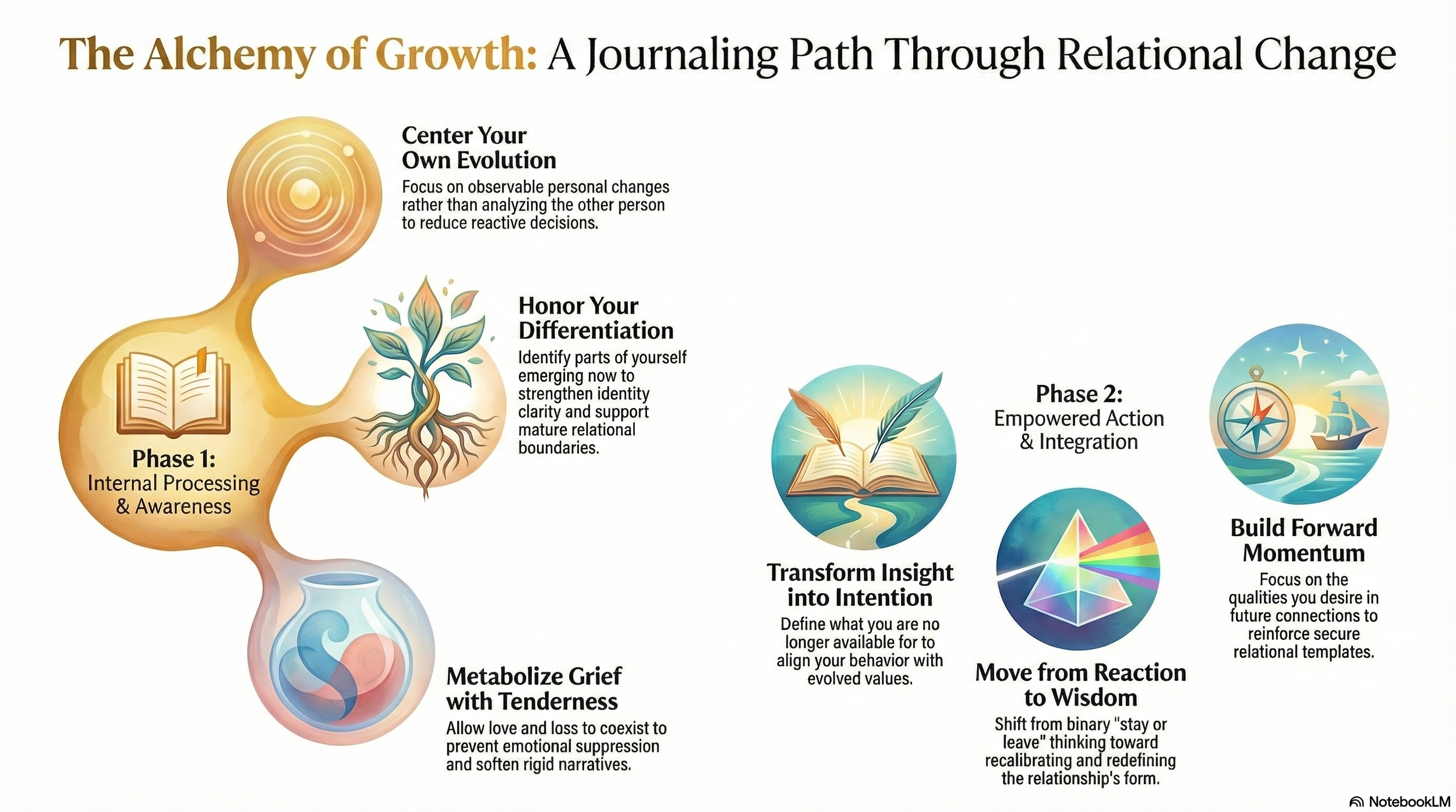
Does your inner circle have room for the person you are becoming? Use the guided journal available at the Embracing Alchemy store to organize your thoughts and values-then make good decisions for yourself and your connections!